June 2-4, 2026
Rosemont, Illinois
June 2-4, 2026
Rosemont, Illinois

June 3-4, 2026
Anaheim, California
Corrosion resistance charts are a great resource to use to find suitable alloys for a given chemical service. However, pay attention to the footnotes and read supporting literature as well, because those corrosion charts are really only reflecting general corrosion with the posted numerical values. One of the other types of corrosion that needs to be considered is crevice corrosion.
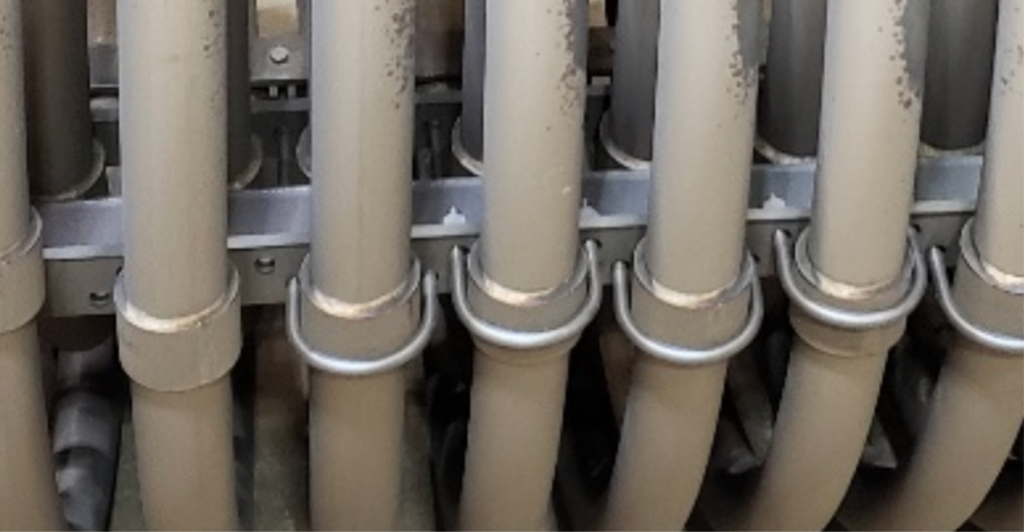
Figure 1 An immersion coil in Tricor’s shop for repair. There are many potential places for crevice corrosion in this design, like where the tubes contact the support beams and the u-bolts around the tubes.
Crevice corrosion is a localized form of corrosion that occurs when a corrosive fluid becomes trapped in the crevices, cracks, or joints of metal surfaces or under deposits. Crevice corrosion initiates in these confined spaces, where the access of oxygen and other oxidants is limited. The presence of stagnant conditions, often caused by capillary forces, allows for the accumulation of corrosive agents within the crevice. Over time, the passive layer, which normally protects the metal from corrosion, can be compromised due to the restricted supply of oxygen and the accumulation of aggressive substances.
There are some important fabrication techniques that can help prevent or reduce crevice corrosion:
If crevices are unavoidable, another approach is to upgrade to a more corrosion resistant alloy in those areas. For example, titanium Grade 7 is generally more resistant to crevice corrosion compared to Grade 2. So, on a titanium Grade 2 vessel design, Grade 7 material can be used in areas where at risk for
crevice corrosion:
By integrating these fabrication practices, the risk of crevice corrosion in pressure vessels can be significantly mitigated, ensuring long-term reliability and safety of the equipment.

Space09 October 2023
Falling through the Solar System at an astonishing 635,266 kilometers (394,736 miles) per hour, NASA’s Parker Solar Probe has just smashed the record for fastest object ever to be created by human hands.
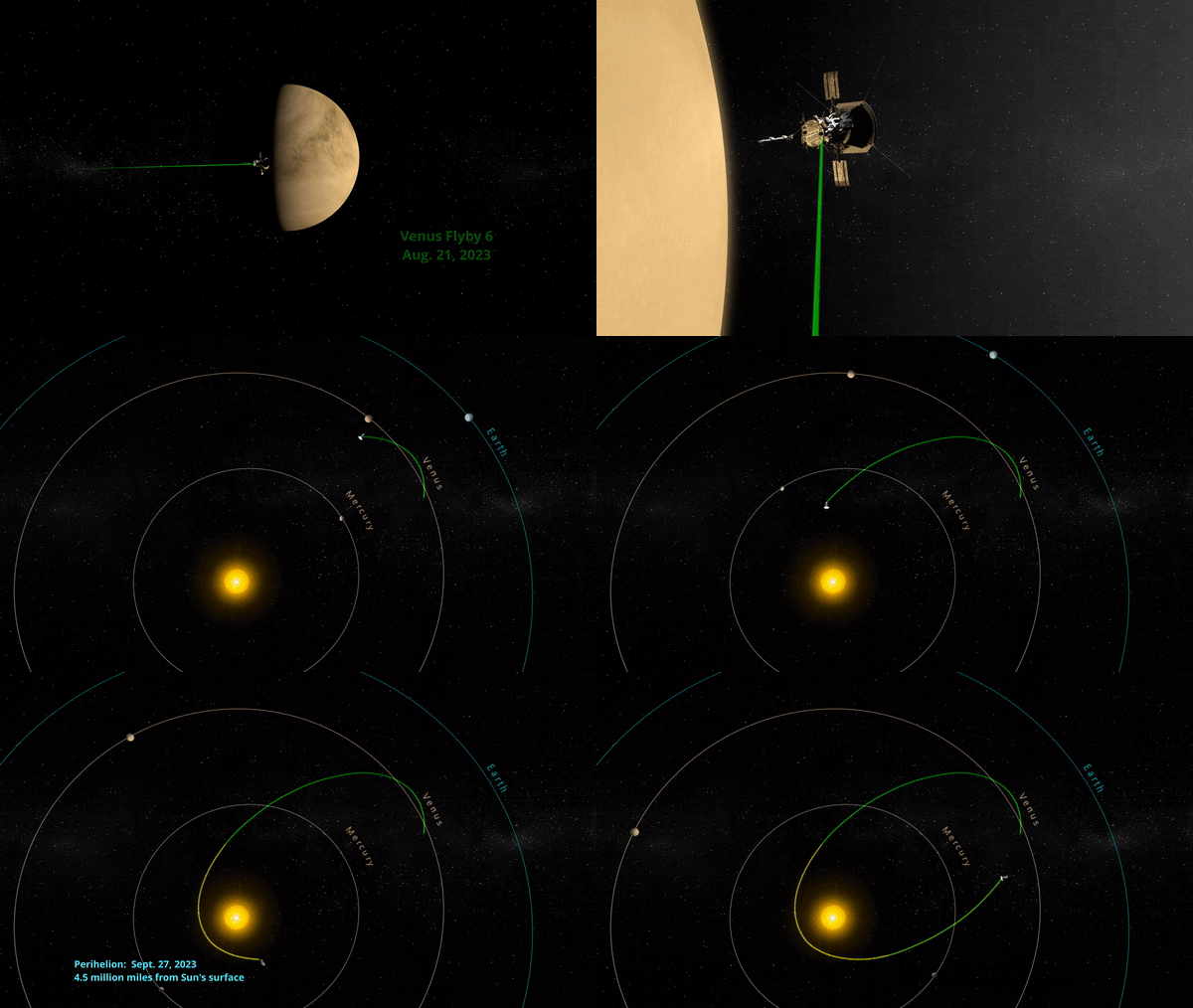
Parker Solar Probe’s 17th orbit brought the spacecraft within 7.3 million kilometers of the Sun. (NASA/Johns Hopkins APL/Steve Gribben)
The event on September 27 marks the turning point of the mission’s 17th loop around the Sun as it collects data on the heated winds of charged particles and violent magnetism that surround our closest star, and comes just under three years after its previous record of 586,863.4 kilometers (364,660 miles) per hour.
At these speeds, it’d be possible for an aircraft to circumnavigate our planet roughly 15 times in a single hour, or zoom from New York to Los Angeles in just over 20 seconds.
Not only is it a record speed, it’s also a record proximity to the Sun – just 7.26 million kilometers above the radiant ocean of plasma we think of as the star’s surface.
Given the Sun is just under 1.4 million kilometers across, this would be akin to standing several respectable paces away from a blazing campfire. Near enough to smell the smoke but not so close that your nose hairs singe.
Achieving such incredible feats wasn’t the result of powerful propellants (at least, not entirely), but more a consequence of a perfectly-timed game of cosmic mini-golf.
For the Parker Solar Probe to get to right where the action is, it needs to slip in and out of the Sun’s corona. Unfortunately we happen to be standing on a mobile launch pad that’s hurtling through space at tens of thousands of kilometers per hour.
NASA used a beefy rocket to line up the shot and putt their heat-shielded ball down the celestial green at a speed intended to help cancel out Earth’s orbiting velocity, and roll it right down the Solar System’s throat.
Timing the probe’s path with the creeping passage of Venus makes use of the planet’s gravity, slowing the probe enough to circle the drain in a slowly-diminishing spiral.
After a total of 24 orbits, the Parker Solar Probe should finally tip over the brink and give the space agency a hole in one; but not before gathering a pile of information that will help us better model the Sun’s behavior.
With another seven laps to go, we will no doubt see these records shattered again, each serving as a reminder of what can be accomplished with a little physics and a whole lot of curiosity.
https://www.sciencealert.com/probe-blazes-new-record-for-the-fastest-thing-ever-made-by-humans

When working with a chemical process equipment fabricator there are many important considerations to be made. The attached White Paper explains the important elements to be considered to ensure a successful project and receive quality chemical process equipment that meets your design specifications, quality expectations and project schedule.
Click Here To Download Working with a Fabricator White Paper
We are proud to announce that Chuck Young, Business Development Manager & Metallurgist at Tricor Metals, has been asked to continue as a member of the board of directions for Materials Technology Institute for the next year – from October 2022 until October 2023 – and has accepted that honor. The new Board will be voted on at the MTI Annual meeting as part of the AmeriTAC meeting in Houston October 24-27.
Chuck has been a BOD member since October 2018 and is currently on the Products Committee, Scholarship & Outreach Committee and the Marketing Subcommittee chair for the Membership Committee.
He is co-Champion of the Case Histories for Knowledge Management project and the 2024 MTI Global Symposium. He is also involved as a project team member on a number of other technical projects including, MIC Corrosion and Duplex SS, Lithium Mining Corrosion of Duplex SS, Detection of Hydrogen Damage in Titanium Tubes and TAC Bulletin Projects.
We congratulate Chuck on this honor and look forward to his continued accomplishments in the coming years!